





Who, What, Where, How to Fix?
Remediation today is too slow and too manual - validating issues, tracing root cause across code and configs, finding owners, and aligning on fixes leaves teams chasing one-off tickets, without the ability to implement remediation strategies that address a wider scope of issues.
Break the Silos. Fix Faster.
Break the Silos. Fix Faster.
ZEST integrates security into DevOps workflows to eliminate the back-and-forth. Automate root cause analysis, trace issues from cloud back to code, and bring solutions (not problems) to your DevOps team with full context into what’s wrong, how it’s managed, and how to resolve it.
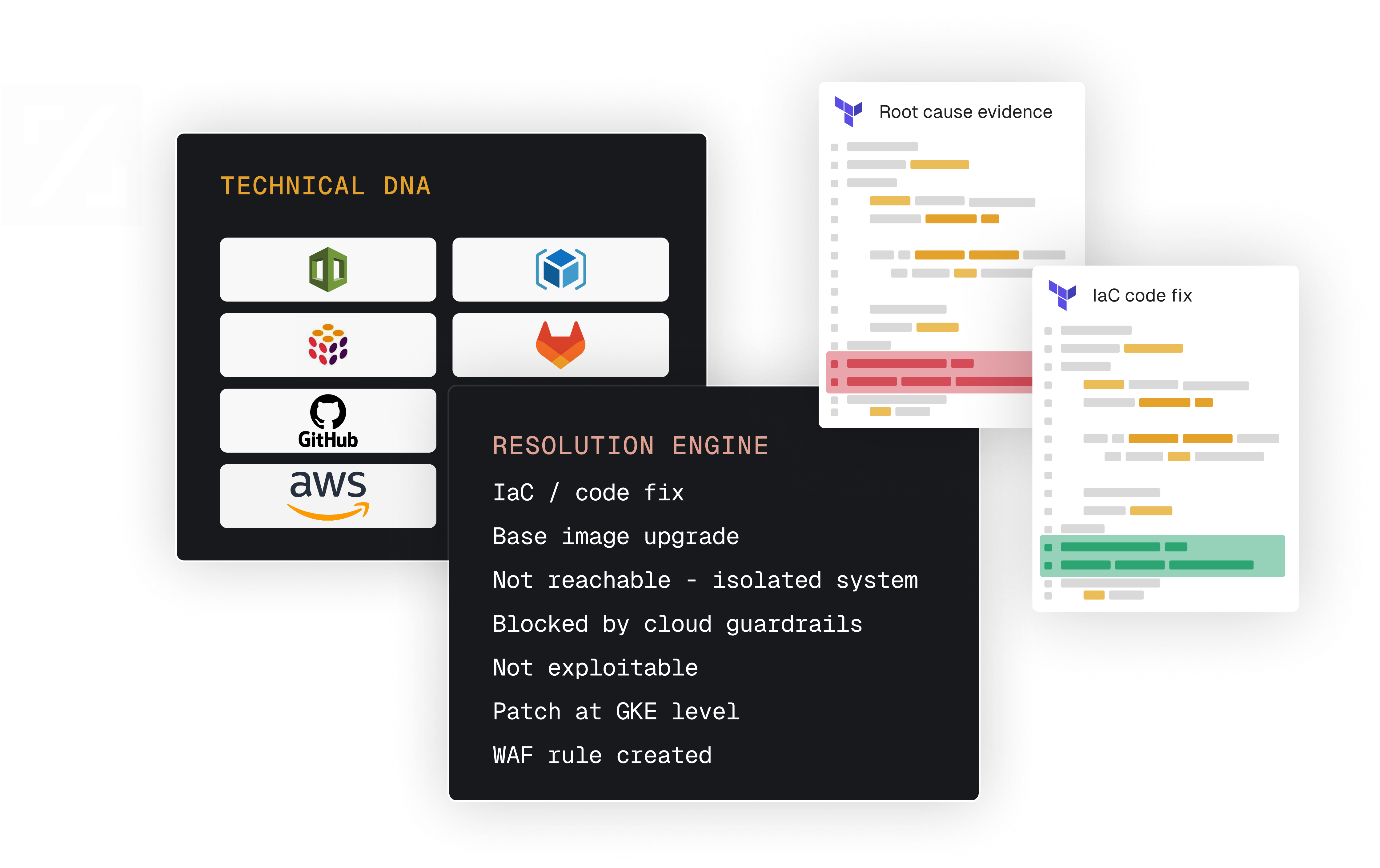
Remediate SCA, IaC, & Product Vulnerabilities
Bridge ASPM visibility with DevOps workflows through integration with IaC systems (Terraform, CloudFormation, etc.) and code repositories, enabling faster and more precise remediation.

Implement Security as Code (SaC)
Remediate cloud misconfigurations directly in Infrastructure as Code (IaC) to resolve today’s issues at scale, while preventing future risks natively in your CI/CD pipelines.

Trace Risks Back to Base Images and Even Deeper
Trace issues back to the base image, installed package, or cluster to implement fixes that address root causes, maximizing risk reduction across your environment.


ZEST approaches application security by bridging the gap between ASPM visibility and the DevOps workflows where fixes actually get applied. Rather than leaving security teams to manually triage findings, trace root causes, and coordinate with engineers, ZEST automates root cause analysis and traces issues from cloud infrastructure back to the code level. The platform then delivers solutions, not just problem descriptions, with full context on what is wrong, how it is managed, and how to resolve it. This fundamentally changes how application security teams operate, replacing reactive ticket management with guided, efficient remediation.
ZEST supports attack surface management by continuously mapping risks across cloud, code, applications, and software supply chain, and aligning them to resolution paths. By identifying where exposures exist and automatically surfacing the most effective path to eliminate them, ZEST gives security teams an active lever for controlling the attack surface rather than simply observing it. Customers use ZEST to proactively resolve attack paths before they can be exploited, shifting from reactive response to continuous attack surface management across the application layer.
ZEST integrates security directly into DevOps workflows by connecting to IaC systems such as Terraform and CloudFormation, as well as code repositories. When an application security risk is identified, ZEST automatically generates the fix and delivers it to the relevant DevOps owner with complete context, eliminating the extended validation cycles and ownership disputes that delay remediation. This integration means that engineers receive actionable, ready-to-review fixes rather than raw vulnerability reports, making application security remediation faster and less disruptive to development velocity.
ZEST's platform correlates risks identified at the cloud or runtime layer back to their source in Infrastructure as Code, container configurations, and code repositories. This traceability is critical for attack surface management, as it allows security teams to address the structural condition that introduced the risk, not just the symptom. For example, a misconfigured cloud resource that creates an application-layer exposure can be traced to the specific IaC block where it originated, and ZEST generates a corrective code fix at that level, preventing the same issue from redeploying.
Yes. One of the most significant challenges for application security teams is the sheer volume of open findings across code, cloud, and supply chain. ZEST uses Agentic AI to group findings by root cause and identify the fix that resolves the largest number of related issues simultaneously. This effort-based approach to prioritization allows teams to eliminate broad swaths of risk with minimal changes, reducing the backlog without requiring proportional increases in engineering effort. Security teams evaluating an attack surface management platform will find this capability directly addresses the operational unsustainability of existing approaches.
ZEST's application security capability extends beyond code and cloud to include software supply chain risks. The platform ingests findings from SCA tools and aligns them to resolution pathways alongside cloud and application vulnerabilities, providing a unified view of risk across the full application stack. By incorporating supply chain findings into the same prioritization and remediation workflow as cloud misconfigurations and code vulnerabilities, ZEST helps security teams manage third-party and open-source risk without operating a separate, disconnected program.
ZEST is designed to complement ASPM solutions, not replace them. ASPMs are effective at providing visibility into application security posture, but they typically stop short of guiding remediation. ZEST acts as the action layer on top of ASPM visibility, ingesting findings and automatically aligning them to resolution paths. This integration bridges the gap between what ASPM platforms surface and what DevOps teams need to actually fix issues, turning application security observations into measurable risk reduction. ZEST natively integrates with leading ASPM solutions as part of its broader security stack connectivity.
The manual validation cycles between security and engineering teams are one of the primary reasons application security remediation is slow. ZEST automates root cause analysis, generates remediation code, and packages each finding with all the context an engineer needs to act, including what the risk is, how it is managed within the organization's environment, and exactly what change will resolve it. By bringing solutions rather than problems to DevOps, ZEST eliminates the multiple rounds of investigation and clarification that typically precede any application security fix.
Fixing a current application security risk is only part of the equation. ZEST embeds prevention into its resolution paths by addressing risks at the code level using IaC, ensuring that future deployments do not reintroduce the same vulnerabilities or misconfigurations. This approach reduces the rate of recurring issues that plague traditional application security programs, where the same types of risks resurface repeatedly because the structural conditions that created them were never corrected. For teams building a mature attack surface management platform strategy, this prevention layer is critical to long-term exposure reduction.
Enterprises using ZEST for application security report faster remediation cycles, fewer escalations between security and engineering, and a measurably smaller open risk backlog across code, cloud, and supply chain. By automating the most manual and time-intensive parts of the remediation workflow, ZEST frees application security teams to focus on strategy and coverage rather than coordination and triage. Customers such as Best Buy have noted that ZEST gives security teams all of their resolution options so they can quickly and confidently close vulnerabilities, a meaningful shift for any organization building a scalable attack surface management program.