





Over 50% of Risks Can’t be Remediated
Risks left unaddressed often get accepted, increasing the potential for security incidents when appropriate mitigating controls aren’t applied.
Cloud Guardrails as a Mitigation Pathway
Cloud Guardrails as a Mitigation Pathway
When remediation isn’t possible or takes too long, ZEST mitigation paths offer an alternative route by leveraging existing security controls, services, and guardrails to reduce exposure, severity, and exploitability.
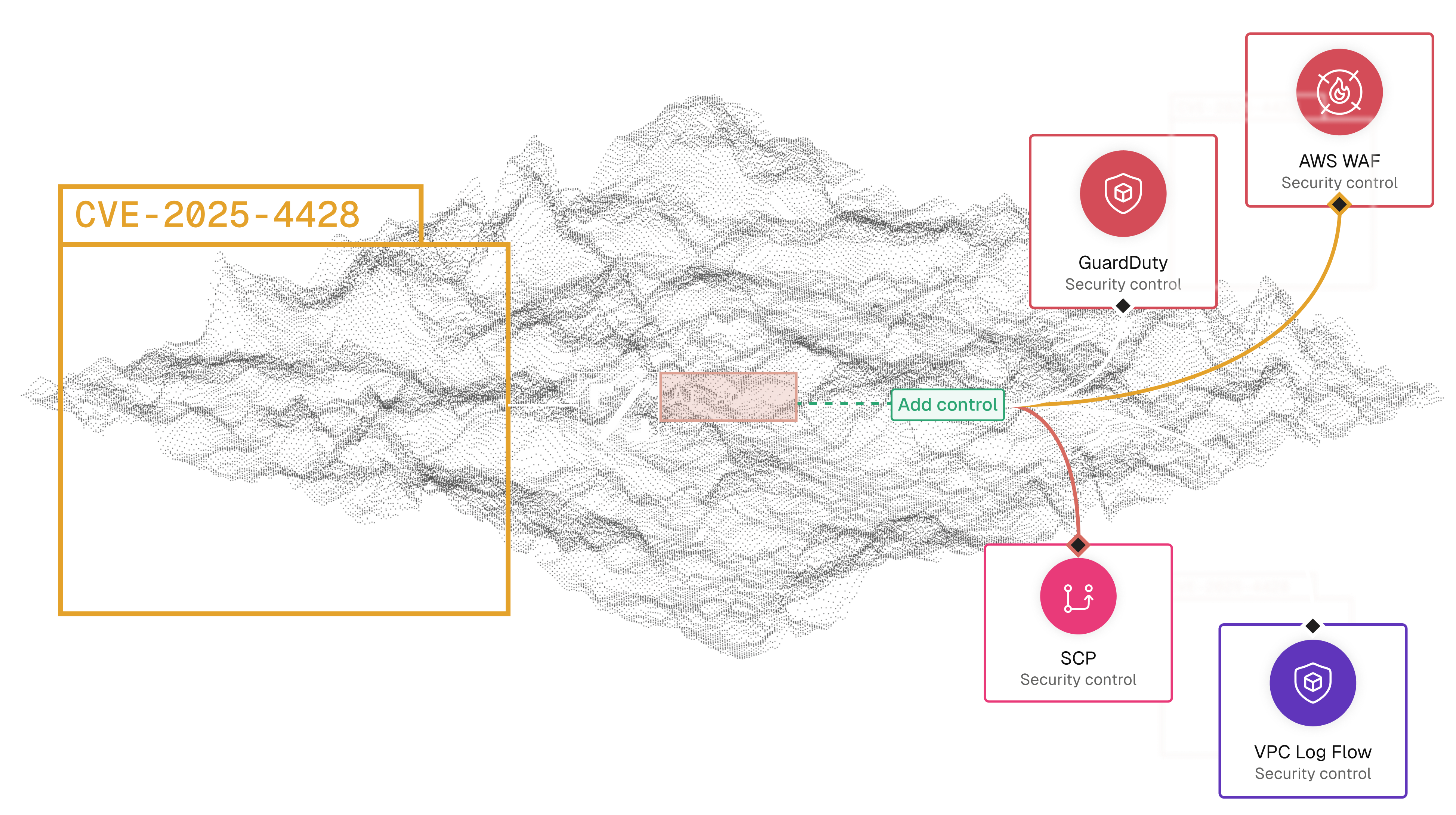

Prevent Exploitation
Use the security tools already at your disposal such as WAF, VPC, SCPs, and GuardDuty, to prevent exploitation and reduce risk while longer-term fixes are underway.

Mitigate When you Can't Remediate
Reduce exposure by mobilizing cloud-native controls to harden configurations, enforce stricter policies, or create customized protection rules when code changes or upgrades just aren’t possible.

Deprioritize Risks Already Covered
Correlate findings with existing coverage to deprioritize risks already addressed, reducing noise and focusing remediation on the issues that reduce critical exposure.


Exposure mitigation is ZEST's approach to reducing risk when full remediation is not immediately possible. Rather than leaving vulnerabilities and misconfigurations unresolved, ZEST's mitigation paths leverage your existing security controls, cloud-native services, and guardrails to reduce the severity, exploitability, and blast radius of open risks. This cybersecurity mitigation capability ensures your environment is actively hardened even while longer-term fixes are planned or underway, closing the gap between risk identification and meaningful risk reduction.
Risks left unaddressed for extended periods are frequently accepted by default, increasing the likelihood of security incidents. Preemptive mitigation addresses this by ensuring that no identified risk sits without a control applied to limit its impact. ZEST's preemptive mitigation capability automatically analyzes your available security controls and identifies which ones can be activated to reduce exposure now, without waiting for a patch or code change. This proactive posture is especially valuable in environments where remediation timelines stretch across multiple teams and approval cycles.
ZEST's mitigation paths draw on the security tools already present in your environment. These include AWS Service Control Policies (SCPs), Web Application Firewalls (WAFs), VPC configurations, and GuardDuty, among other cloud-native services and guardrails. Rather than requiring new tooling, ZEST mobilizes your existing investments to enforce stricter policies, harden configurations, and create customized protection rules where code changes or upgrades are not yet possible. This makes cyber security risk mitigation faster to deploy and easier to operationalize at scale.
ZEST's Agentic AI analyzes your environment's specific technical context to identify which available controls are most effective at reducing a given risk's exploitability. The platform simulates the impact of potential mitigation options before recommending them, factoring in existing guardrails, cloud-native services, and coverage gaps. It then presents security teams with the highest-impact path for their environment, including the specific controls to activate and how to configure them. This removes the manual research and cross-team back-and-forth that typically slows cybersecurity mitigation programs.
Yes. A key benefit of ZEST's mitigation capability is the ability to deprioritize findings where existing controls have already reduced exploitability to an acceptable level. By analyzing your current security coverage, ZEST identifies risks that are effectively neutralized by active guardrails and removes them from the active remediation queue. This reduces alert noise, focuses engineering effort on genuinely high-impact issues, and gives security teams a more accurate picture of their real exposure, rather than an inflated backlog of technically open but practically covered risks.
Risk acceptance is a passive decision that leaves exposure unchanged and undocumented. Preemptive mitigation is an active intervention: ZEST applies existing controls to reduce exploitability and severity while remediation is being planned or executed. The distinction matters for compliance, audit readiness, and overall security posture. Where a risk acceptance entry in a spreadsheet provides no actual protection, a ZEST mitigation path reduces the attack surface in real time. Customers use this capability to demonstrate continuous risk reduction to stakeholders and auditors, even for risks that cannot be fully patched immediately.
ZEST announced the addition of AWS SCPs as part of its broader exposure mitigation offering, specifically targeting non-remediable risks. SCPs provide a powerful, code-free mechanism for restricting permissions and enforcing policy boundaries across AWS accounts and organizational units. When ZEST identifies that a risk cannot be patched through a traditional code fix, it may recommend activating an SCP to prevent the vulnerable action from being exploited at the organizational level. This gives enterprise security teams a scalable mitigation lever that does not require DevOps intervention or application-layer changes.
ZEST operates with read-only access to your cloud environment and does not apply any changes directly. All recommended mitigation actions are surfaced with full context, including what the control does, which risks it addresses, and what the expected impact will be on your environment. Security teams review and approve every action before implementation. ZEST also simulates mitigation outcomes on a digital twin of your environment before recommending them, helping ensure that the controls activated are effective and appropriate without introducing unintended disruptions.
Yes. ZEST's approach to exposure mitigation aligns closely with Continuous Threat Exposure Management principles, which prioritize continuous validation, remediation automation, and intelligent attack surface management. By ensuring that every identified risk is mapped to either a remediation or mitigation path, ZEST supports the end-to-end exposure management lifecycle that CTEM frameworks require. Organizations that have adopted CTEM as a strategic initiative use ZEST's mitigation capabilities to operationalize the mobilize and validate stages of the framework at a speed and scale not achievable through manual processes.
Security teams using ZEST's mitigation capabilities report faster time-to-coverage for open risks, a smaller effective attack surface, and reduced pressure on DevOps teams to deliver immediate patches. By mobilizing existing controls to address risks in parallel with longer-term remediation work, teams avoid the scenario where risks sit open and unmanaged for weeks. ZEST customers have used mitigation pathways alongside remediation to proactively resolve attack paths and quickly address cloud vulnerabilities and misconfigurations, demonstrating measurable improvement in overall security posture without adding headcount or tooling.