





Visibility ≠ Security
Today’s security tools are great at surfacing risks, but remediation is still painful. New findings emerge rapidly. Old issues continue to resurface. Security teams are up against an endless backlog of misconfigurations, policy violations, and vulnerabilities, while burning out.
Turn Risk into Resolution
Turn Risk into Resolution
ZEST shifts the focus from identifying risks to efficiently resolving them. The platform unifies risks across your security stack and automatically maps them to prioritized resolution paths that remediate, mitigate, and prevent exposure - finally tackling the endless backlog of unresolved issues.
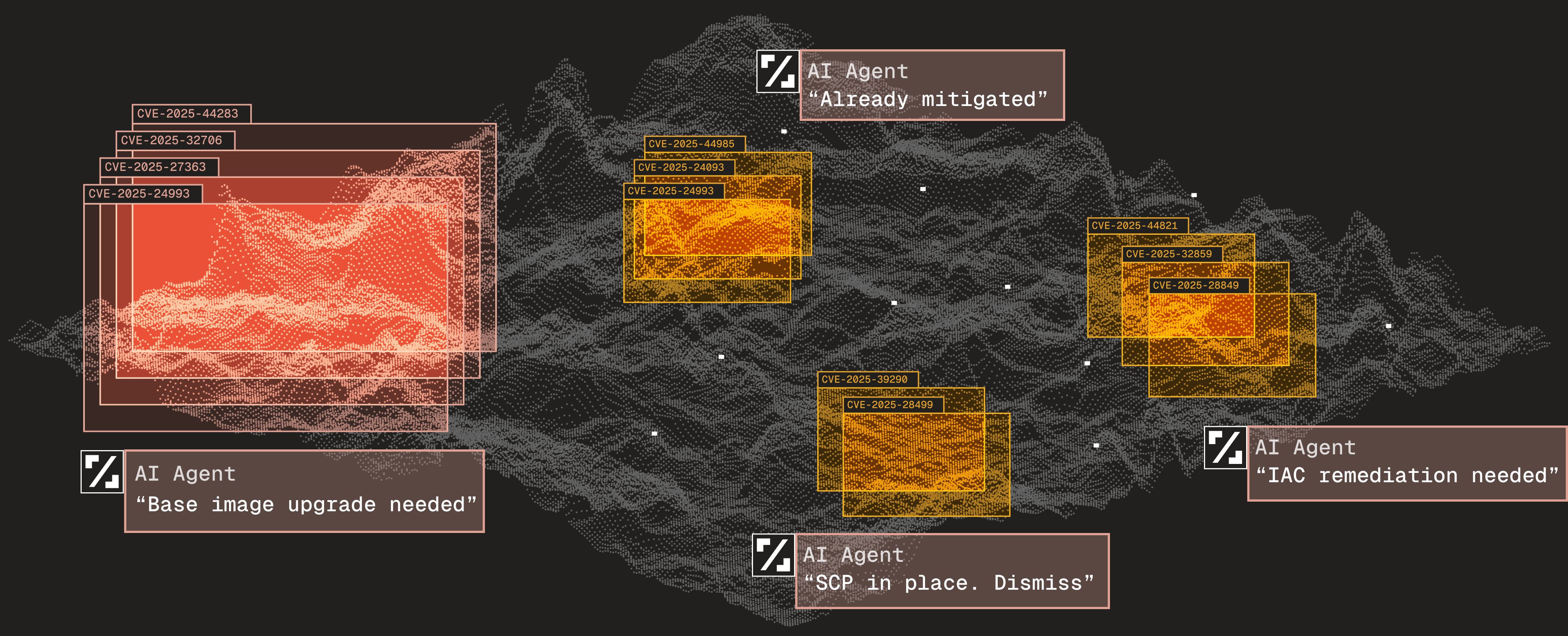

Eliminate Your Backlog with AI
What used to be manual - triage, root cause analysis, fix identification, and prioritization - is now fully automated using AI Agents, removing bottlenecks that slow down remediation.

Fix Thousands of Risks at Once
Remediate thousands of related risks at once by addressing issues at their root cause - whether in IaC, container images, or cloud instances.

Mitigate When You Can’t Remediate
When remediation isn’t possible or takes too long, mobilize existing security controls, cloud-native services, and guardrails to mitigate risk right away.


ZEST Security goes beyond detection-only tools by shifting the focus from surfacing risks to actually resolving them. While most vulnerability management platforms excel at identifying misconfigurations and CVEs, they leave security teams with an ever-growing backlog and no clear path forward. ZEST's AI-powered platform unifies risks across your existing security stack and automatically maps them to prioritized resolution pathways, covering remediation, mitigation, and prevention. The result is a vulnerability management platform built to drive outcomes, not just alerts.
ZEST's vulnerability prioritization engine analyzes each risk in the context of your environment's unique technical DNA, factoring in reachability, exploitability, and business context to surface what truly matters. Many vulnerabilities cannot realistically be exploited in your specific environment. ZEST's proprietary analysis and threat intelligence identifies those vulnerabilities automatically, so your team can deprioritize noise and focus remediation effort where it drives maximum exposure reduction. This context-aware approach is central to effective vulnerability risk management at enterprise scale.
A Resolution Path is ZEST's structured approach to closing a risk, combining remediation, mitigation, and prevention into a single workflow. Traditional vulnerability remediation management focuses on patching one risk at a time, which is slow and often leads to recurring issues. ZEST simulates all potential remediation options, identifies the highest-impact path for your environment, and when a patch isn't immediately available, deploys existing security controls and cloud-native guardrails to mitigate exposure right away. Prevention strategies are also embedded to stop the same risk from resurfacing.
Not every vulnerability can be patched immediately, due to business constraints, unavailable owners, or the absence of a patch. ZEST addresses this head-on with its preemptive mitigation capability. When remediation isn't an option, ZEST mobilizes existing security controls such as AWS SCPs, WAFs, VPC configurations, and GuardDuty to harden the environment and block exploit paths without waiting for a fix. This ensures your cyber risk management program remains active and effective even in scenarios where traditional remediation stalls.
ZEST is built to eliminate risk at root cause, which means a single fix, such as a patch, IaC update, code change, or configuration correction, can resolve thousands of related vulnerabilities simultaneously. By grouping issues that share a common root cause and addressing them at the source (whether in Infrastructure as Code, container images, or cloud instances), ZEST dramatically reduces backlog volume with minimal effort. This is a core differentiator in vulnerability remediation management compared to ticket-by-ticket approaches.
ZEST is designed to complement your current security stack, not replace it. It integrates with existing CSPM, ASPM, and other cloud risk assessment tools in minutes, ingesting findings and aligning them to resolution pathways automatically. For DevOps teams, ZEST generates ready-to-use fixes, including Terraform code, so engineers receive solutions rather than just problem descriptions. This eliminates the back-and-forth between security and engineering teams that typically delays cyber security risk management programs by weeks.
ZEST uses Agentic AI to automate the most time-consuming parts of the remediation lifecycle, including triage, root cause analysis, fix identification, and vulnerability prioritization. Tasks that previously required weeks of manual effort and cross-team meetings are now handled autonomously by AI Agents. ZEST also released AI Sweeper Agents, which analyze exploitability across real environments to dismiss non-actionable alerts at scale. In 2025, ZEST customers used these capabilities to dismiss over 11 million vulnerabilities and significantly cut remediation toil.
Recurring risks are one of the most persistent challenges in cyber risk management, with approximately 80% of risks resurfacing after remediation. ZEST addresses this by embedding prevention strategies into every Resolution Path. After a risk is resolved, ZEST delivers preventative measures designed to stop the same or similar issues from re-emerging. By leveraging Infrastructure as Code to trace risks back to their origin and fix them at the source, ZEST reduces the likelihood of human error and eliminates the structural conditions that allow misconfigurations and vulnerabilities to reappear.
ZEST's platform traces risks from cloud infrastructure back to the code level, enabling security teams to remediate issues directly in IaC and address current exposures while preventing future drift. For teams already using cloud security tools, ZEST acts as a remediation layer on top of existing visibility, aligning cloud risk assessment findings to actionable resolution paths at a speed and scale not previously possible. ZEST has demonstrated its value across GCP, AWS, and other cloud environments, including helping teams identify unmanaged cloud infrastructure outside of Terraform deployments.
Organizations using ZEST have reported significant reductions in remediation time, fewer cross-team escalations, and a substantially smaller open risk backlog. One customer noted that ZEST helped navigate top compliance challenges by aligning requirements to their vulnerability management and risk remediation programs. Another highlighted how ZEST enables their team to proactively resolve attack paths and address cloud vulnerabilities and misconfigurations with both remediation and mitigation. For security teams evaluating a vulnerability management platform, ZEST offers a clear shift from reactive alert management to proactive, measurable risk reduction.